PetaBisnis: Choose a Business Location with Data
Before renting a place for a new shop, owners need to know where the competitors are, how busy the area is, and what the risks are. PetaBisnis answers these questions with a location study for any area in Indonesia.
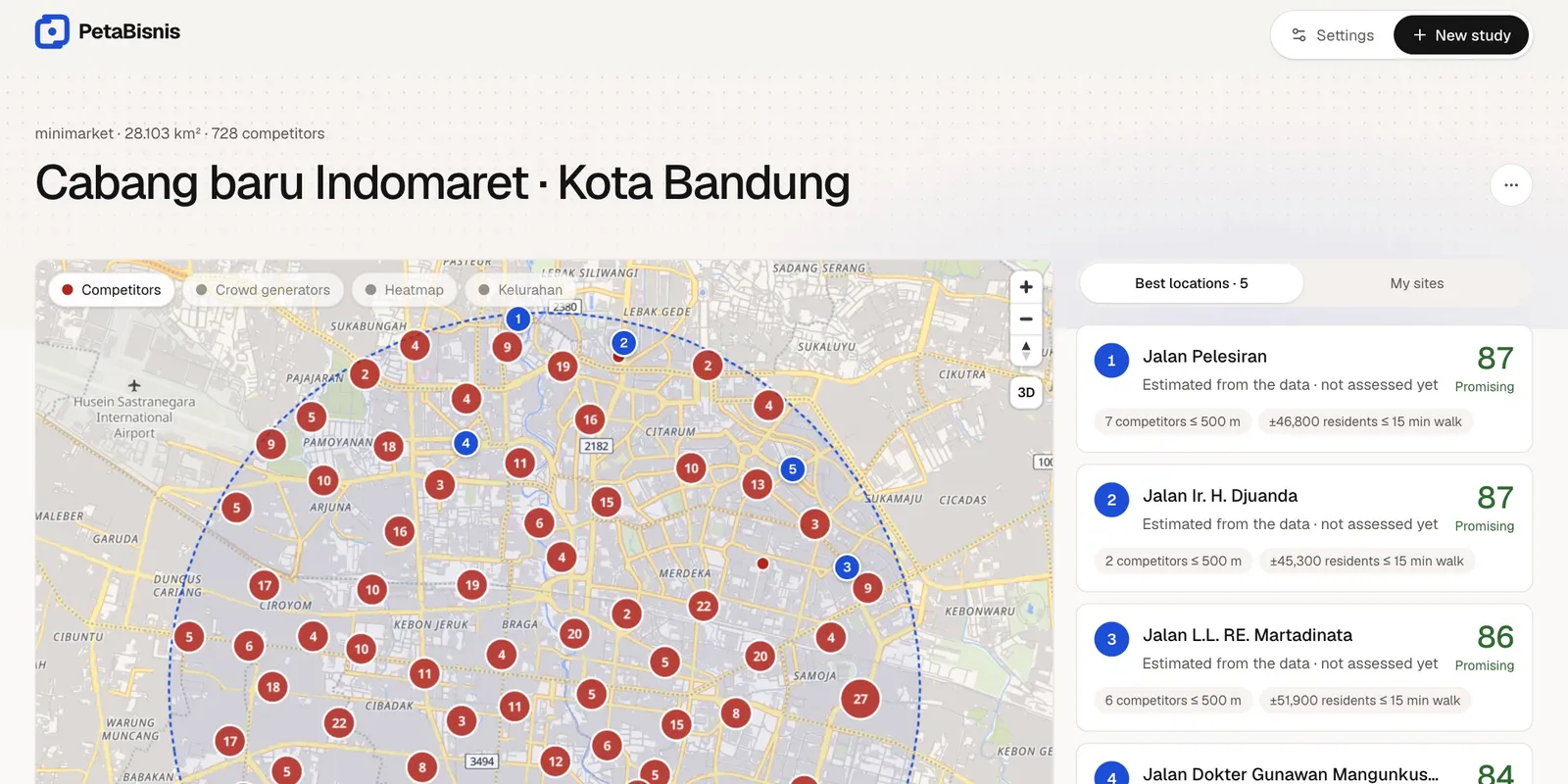
Renting a place is often the biggest cost of opening a shop, and many owners decide based on feeling. They walk down the street, see a few people pass by, and hope the area is right. Problems only show up months later: a competitor turns out to be just around the corner, or the street floods every rainy season.
PetaBisnis is a location study tool from Siberaman for businesses in Indonesia. It answers the important questions before you sign a lease: where the competitors are, how busy the area is, and what the risks are. It works for a first shop and for a new branch, without days of surveying and without difficult terms.
Answer three questions, and PetaBisnis does the rest#
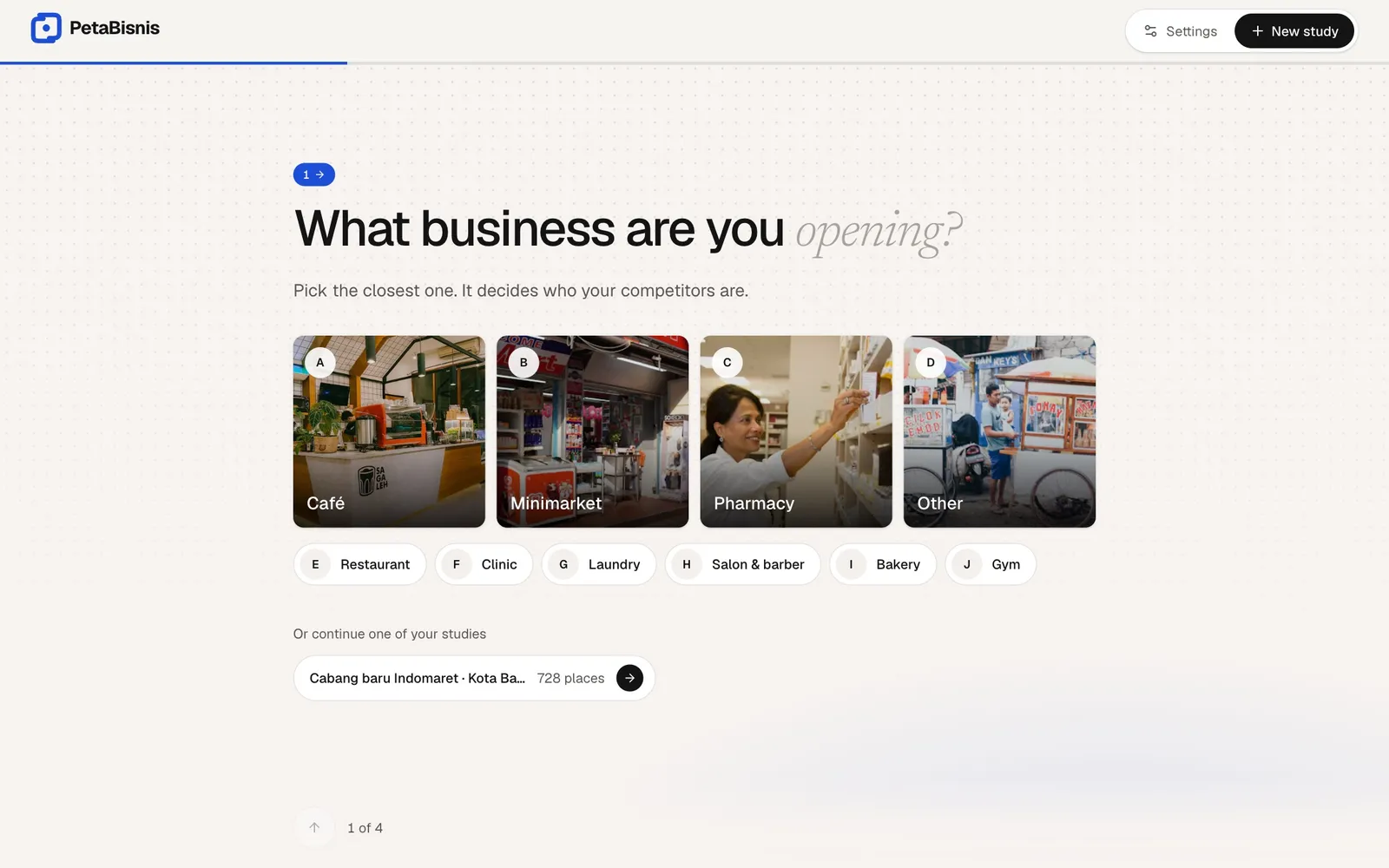
A study starts with the type of business. Café, minimarket, and pharmacy have their own buttons, next to restaurant, clinic, laundry, salon and barber, bakery, and gym. For other businesses, you can describe them in your own words. This choice is important, because it decides which places count as competitors.
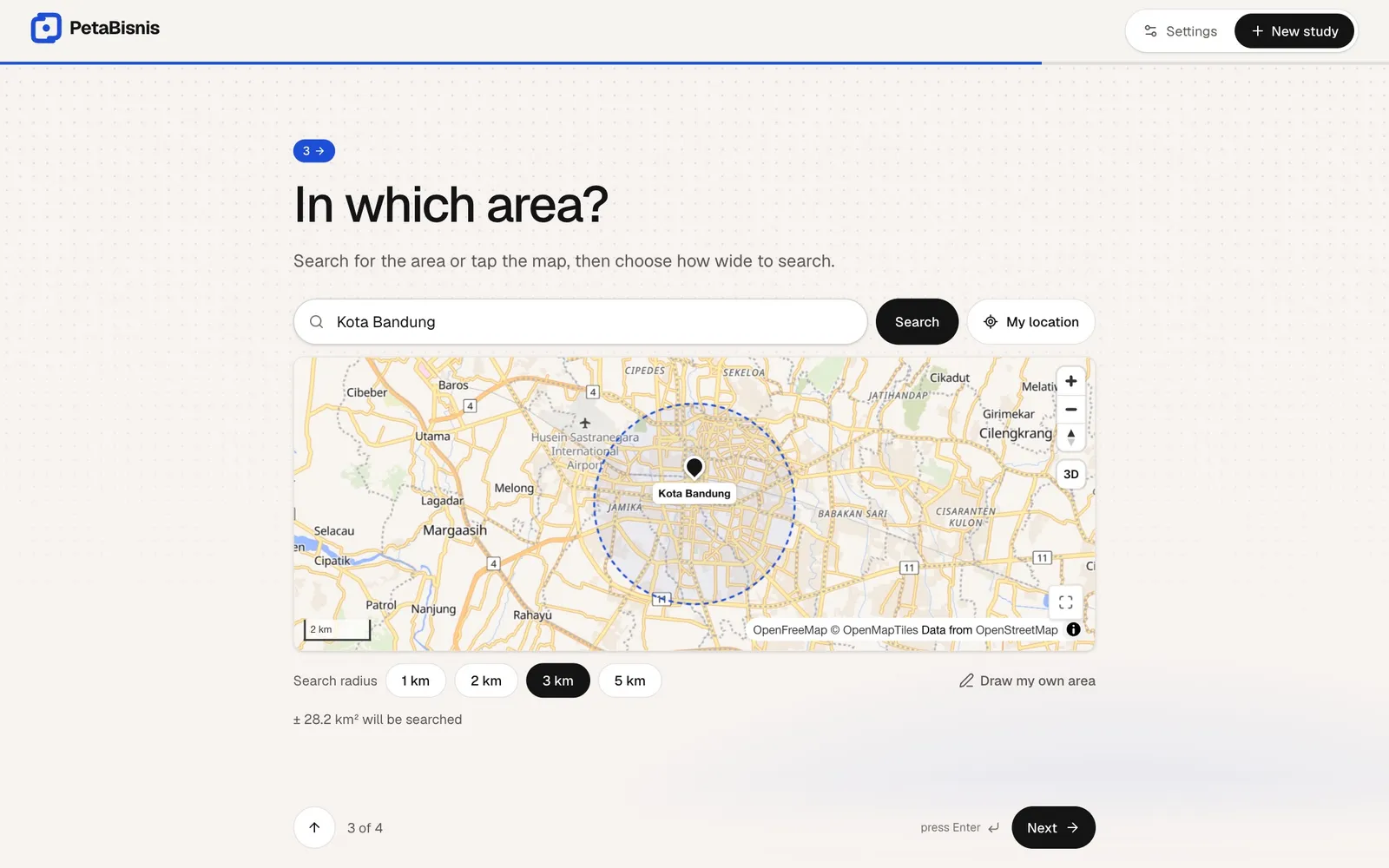
Next, choose the area. Search for a place or tap the map, then choose a search radius of 1, 2, 3, or 5 kilometres, or draw your own area. PetaBisnis shows how large the area is before the search starts. In the example study in this article, a 3-kilometre radius around central Bandung covers about 28 square kilometres.
After that, PetaBisnis collects and checks the data around the area by itself. A study usually takes 10 to 30 minutes, depending on the size of the area. You do not need to keep the page open. The results appear when they are ready.
What makes a location busy or quiet#
PetaBisnis shows the things that decide whether a location works on one map:
- Competitors of the same type, so a new shop does not open right next to a well-known one.
- Crowd generators such as traditional markets, campuses, offices, and malls, which bring people past the shop.
- Walking distance and road access, including how many people live within a short walk.
- Hongsui, the local name for feng shui, which many business owners in Indonesia still consider.
- Flood risk around the location.
What matters most depends on the business. A café needs streets full of workers and students, but not already full of cafés. A minimarket needs enough homes within walking distance and no other minimarket right next door. A pharmacy or clinic must be easy to reach, easy to see from the street, and safe from floods.
All competitors in one table#
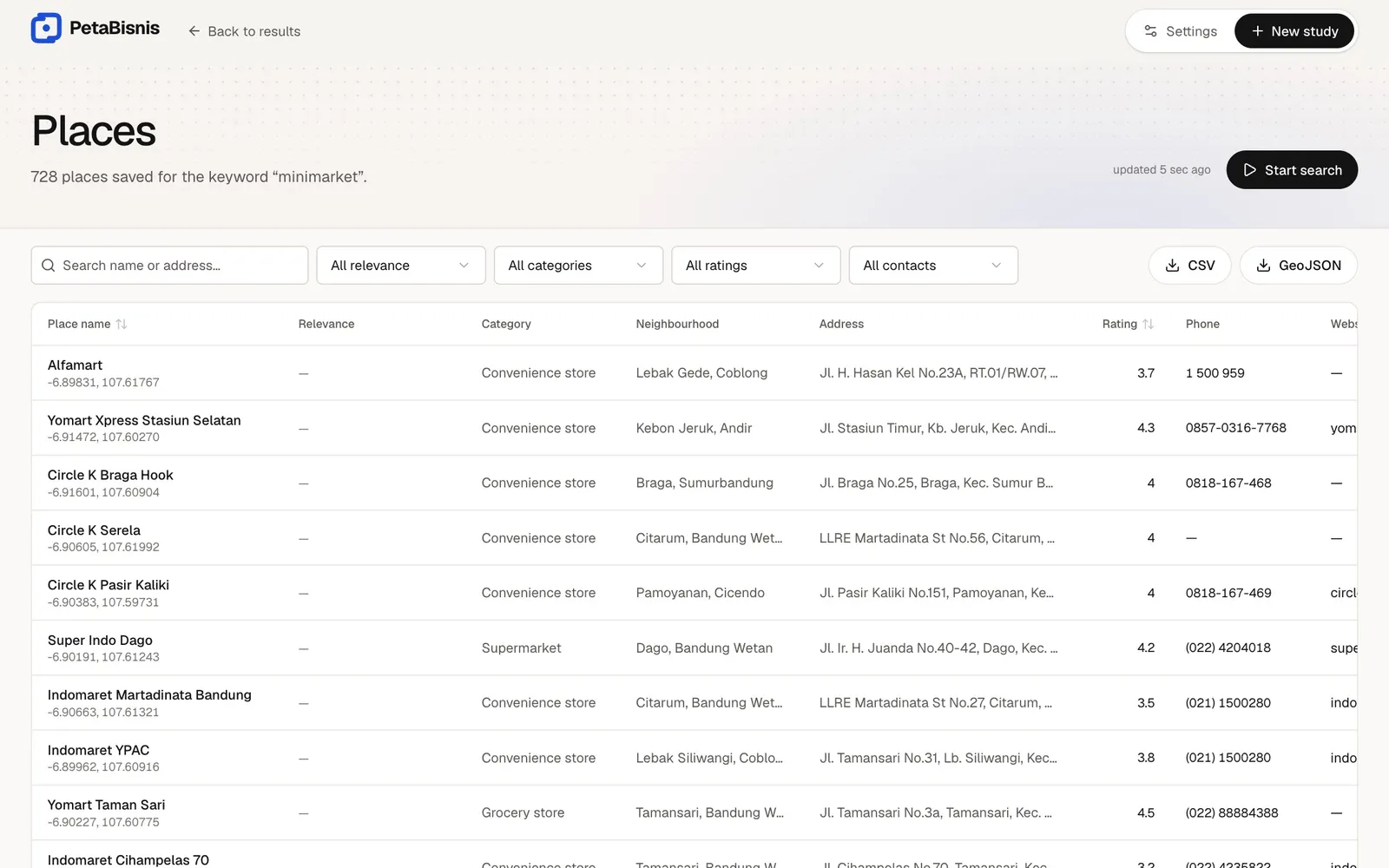
Every similar business in the area is listed in one table, with its category, neighbourhood, address, rating, and contacts. The example minimarket study found 728 places. You can search and filter the table, and download it as a CSV or GeoJSON file to use in a spreadsheet or a GIS application.
The best locations, and the reasons#
The results page shows the five best locations, ordered by score, on the same map as all the competitors. Every location shows the numbers behind its score. In the example, Jalan Pelesiran scores 87, with seven competitors within 500 metres and about 46,800 people living within a 15-minute walk. You can switch the map between competitors, crowd generators, a heatmap, and kelurahan borders.
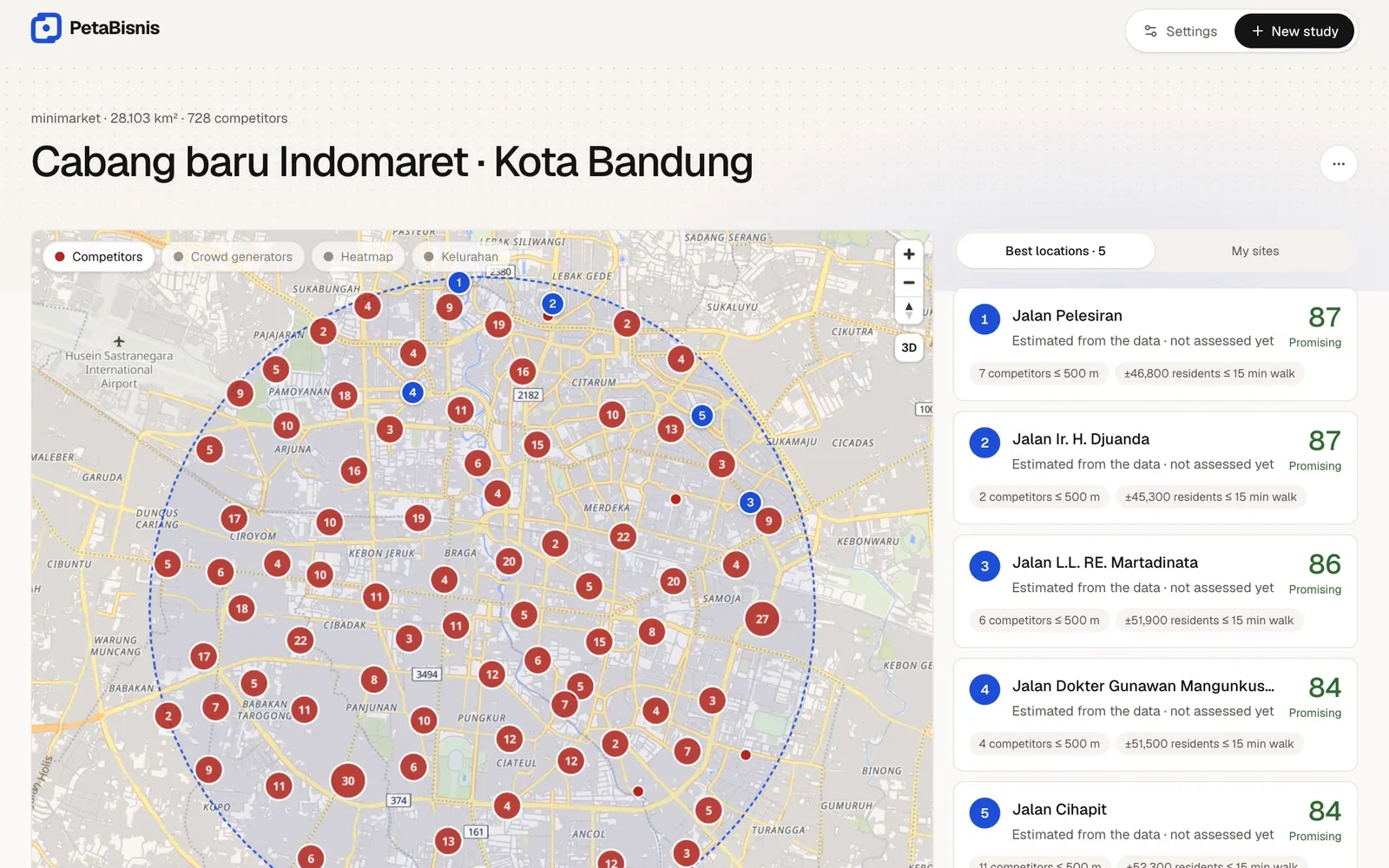
You can also correct the study. Mark what is right or wrong, or reject a location that does not fit, and PetaBisnis calculates everything again with your corrections.
How PetaBisnis estimates market share#
The number of competitors tells us how crowded an area is. It does not tell us how many customers are left for a new shop. For that, PetaBisnis uses the Huff model, a market share model that David Huff published in 1963. Retail planners still use it today. The idea is simple: people usually go to the nearest shop, but a better shop can pull them from further away.
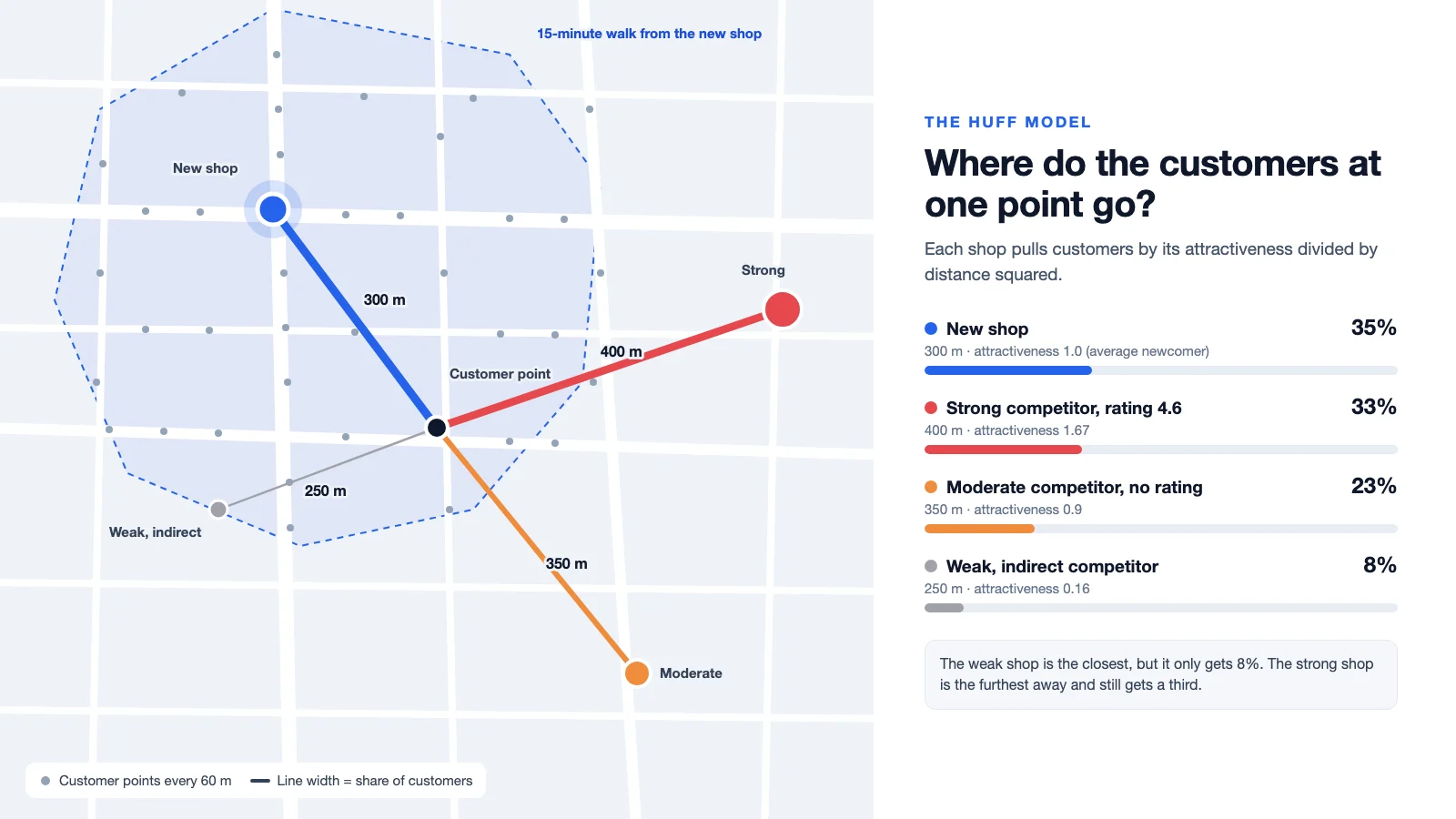
PetaBisnis puts a customer point every 60 metres along the streets within a 15-minute walk, and each point counts as 1. Crowd generators within the walk add more customers, because they bring more people.
Every street point within a 15-minute walk counts as 1. A crowd generator inside the walk adds its weight on top.
View data
| Demand weight | |
|---|---|
| Mall | 9 |
| Campus | 9 |
| Traditional market | 6 |
| Station | 6 |
| Office | 3 |
| School | 3 |
| Supermarket | 3 |
| Hotel | 3 |
| Stadium or venue | 3 |
| Hospital or clinic | 1.5 |
| Place of worship | 1 |
For each customer point, the chance that its customers choose the new shop is:
chance = (1 / d²) / (1 / d² + sum of A / d_competitor²)Here d is the road distance from the new shop to the customer point, and d_competitor is the distance from each competitor. Competitor distances use a straight line plus 30 percent, because roads are never perfectly straight. Any distance under 40 metres is counted as 40 metres, so a point right at the door does not decide everything. The new shop is treated as an average newcomer with a score of 1. Each competitor is first marked as strong, moderate, or weak, and as a direct competitor (the same kind of business) or an indirect one (a business that only partly overlaps). Its attractiveness A is three numbers multiplied together:
| Factor | Value |
|---|---|
| Strength | 1.6 strong, 1.0 moderate, 0.6 weak |
| Rating | average rating ÷ 4.4, between 0.6 and 1.2; 0.9 if there is no rating |
| Relevance | 1.0 direct competitor, 0.3 indirect competitor |
The average chance over all customer points is the expected market share of the location. But a share alone is hard to judge. Twenty percent is good if there are four competitors and bad if there are none. So PetaBisnis compares it with the fair share: the share the shop would get if every shop were equally close to every customer. The fair share is 1 ÷ (1 + the total attractiveness of the competitors within the walk). If the market share is bigger than the fair share, the location itself is helping. If it is smaller, the location is working against the shop.
An example: three moderate competitors without ratings sit within the walk. The fair share is 1 ÷ (1 + 3 × 0.9), about 27 percent. If the calculated share is 35 percent, the location wins more than its fair part, because more customers live closer to it than to the competitors.
A report you can share#
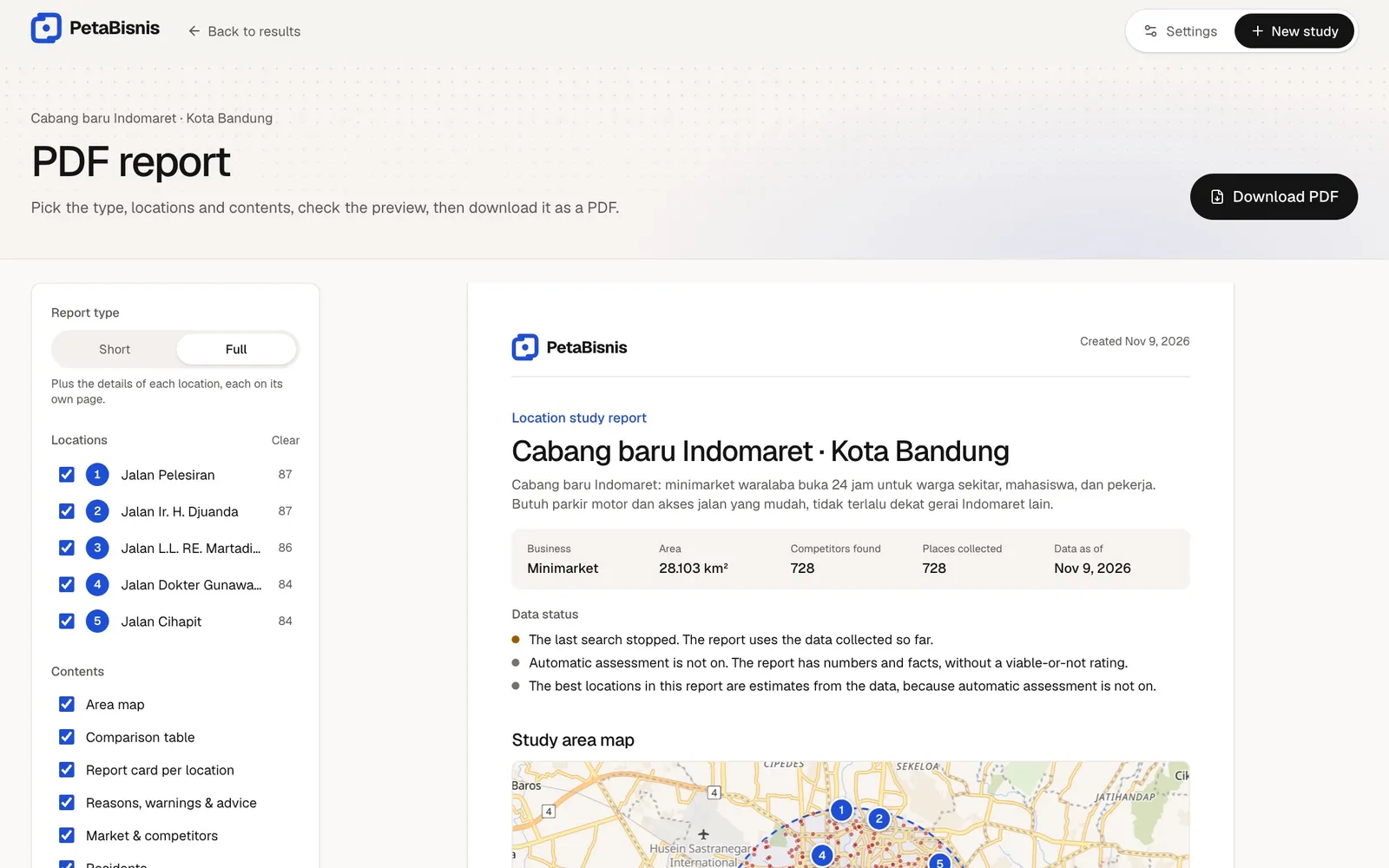
Each study can be saved as a PDF report. Choose a short or a full report, pick the locations, and choose what to include: the area map, a comparison table, a report card for each location, reasons and warnings, and details about the market and competitors. You can see the report before you download it, so it is ready to send to a partner, the owner of the building, or a bank.
An estimate, not a promise#
PetaBisnis helps you narrow down the choices, but it cannot promise that a shop will be busy. The results are estimates based on the data around each location. Before you sign anything, visit the best streets yourself and check the rent, the people passing by, and the parking.
PetaBisnis is available at petabisnis.siberaman.id and works on a phone or a laptop.
Continue exploring
Related articles

Research
Jejak Identitas Indonesia dalam Bisnis KYC Claude
Foto pertemuan, dua video, percakapan forum, dan penawaran jasa menuntun penelusuran atas dugaan pemanfaatan identitas warga Indonesia untuk verifikasi akun Claude.

Research
From Moodle Assignment Upload to Ghostscript Code Execution
How a memory error in Ghostscript can affect Moodle assignment conversion. The latest Moodle release can still be exposed if its server uses a vulnerable Ghostscript installation.
Knowledge for a better understood world.

Research
From Browser Tab to Ransomware: Encrypting Local Files with the File System Access API and Web Crypto
A malicious website can ask Chrome users to “compress photos” and, with one folder permission, encrypt every file in place using only browser APIs. No download, no extension, no native malware. This article breaks down the attack chain, the hybrid RSA/AES design, what works on Android and desktop, and what does not.